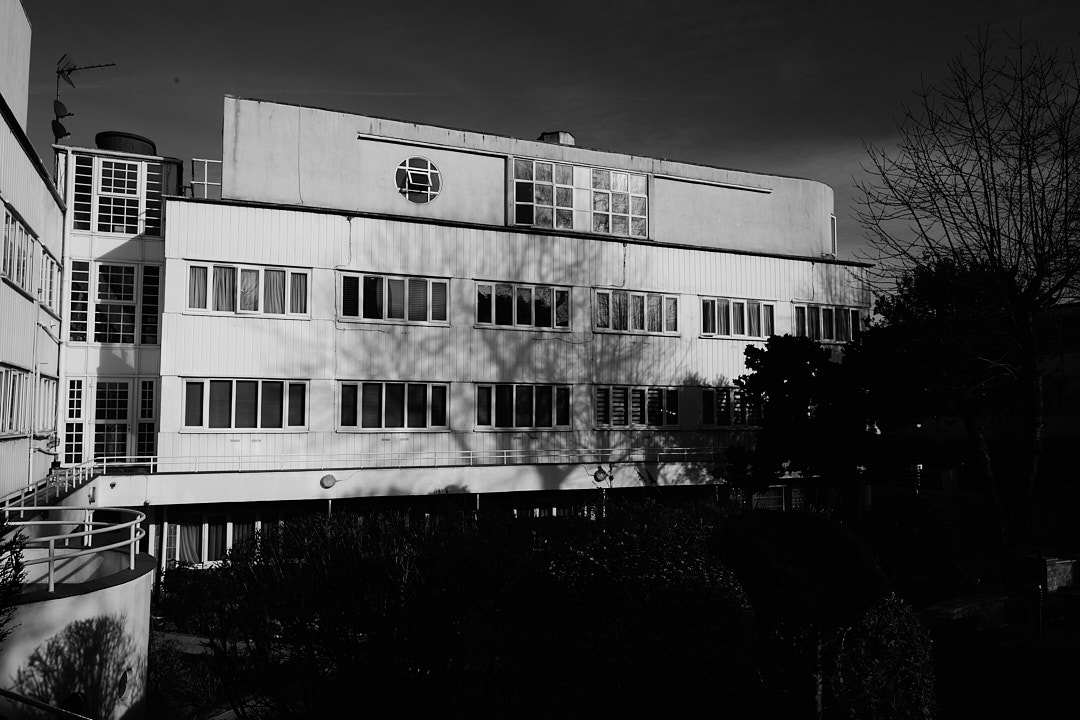
“He … very soon became identified with the international modern movement that was drawing the most talented of the younger generation of British architects into its orbit” The Times, 21st August 1982
In 1937, at the age of 30, A V Pilichowski’s work was included in an exhibition at the Museum of Modern Art (MoMA) in New York entitled ‘Modern Architecture in England’. Alongside his designs for Highfield Court, Whittinghame College and Earl’s Terrace flats in Edwardes Square, Kensington, were the works of some of Modernism’s most illustrious names: Walter Gropius, formerly Director of the Bauhaus school, former Bauhaus teacher Marcel Breuer, Serge Chermayeff, L. Moholy-Nagy, Wells Coates, Maxwell Fry, Frederick Gibberd, Valentine Harding, Lindsey Drake and F.R.S Yorke among others.
In this mix of immigrant and English-born talent, Pilley had a foot in both camps. Born in France to Polish Jewish parents, he arrived in England with his three siblings around 1913 when he was just six years old. So, unlike many of his modernist contemporaries who fled Nazi Europe in the 1930s, he was educated in England, naturalised as a British subject and established with his artistic family well before he started his architectural career.
His family settled at 7, Hill Road, St John’s Wood, an address which became not only his parents’ studio but something of a ‘salon’ and meeting place for the Jewish intelligentsia of the day, with visits from Einstein among others. His mother Lena (‘Madame Pillico’ 1884-1947) was an artist and fabric designer described as ‘in the modern spirit’ and was one of the first women to exhibit with the Seven and Five Society between 1923 and 1927, during which time the group was inviting artists with more modern and abstract styles into the group. His twin sister, Thea Doniach, was also an artist of international repute who studied at St Martins School of Art and Goldsmiths’ College, London.